
How TMS Helps Military Families in Kansas City
Kansas City carries more military weight than most people realize. Fort Leavenworth sits about 30 to 40 minutes northwest, one of the oldest active Army posts west of the Mississippi. Whiteman Air Force Base, home to the 509th Bomb Wing, is another 60 to 90 minutes southeast. Between the two, the metro is home to a large population of active-duty service members, reservists, veterans, and the families who love them.
That population also carries a specific, well-documented pattern: PTSD and depression frequently show up together, in service members and in the people supporting them at home. That overlap can make treatment feel more complicated than it should. This article walks through how TMS therapy, a newer option now available at Armstrong Family Counseling, addresses both conditions, and why it’s worth considering for any family member dealing with depression, not just the veteran.
Why PTSD and Depression Show Up Together After Service
PTSD and major depressive disorder co-occur at high rates. Combat exposure, deployment, and the difficult process of reintegrating into civilian or family life afterward can trigger both conditions at once, and each one tends to make the other harder to manage.
The effects rarely stay contained to the service member. Spouses who spend months or years supporting a partner through PTSD often develop their own anxiety and depression, sometimes called secondary traumatic stress. Children living through deployment separations, frequent moves, and a parent’s difficult return home carry a version of this weight too. A single military household can easily have more than one person quietly struggling at the same time.
How TMS Treats the Depression Behind PTSD
TMS is FDA-cleared for major depressive disorder, not for PTSD itself. However, PTSD and depression overlap so often that treating depression with TMS has carry-over benefit for PTSD. Patients frequently see relief from PTSD when receiving TMS treatment for depression as a primary condition.
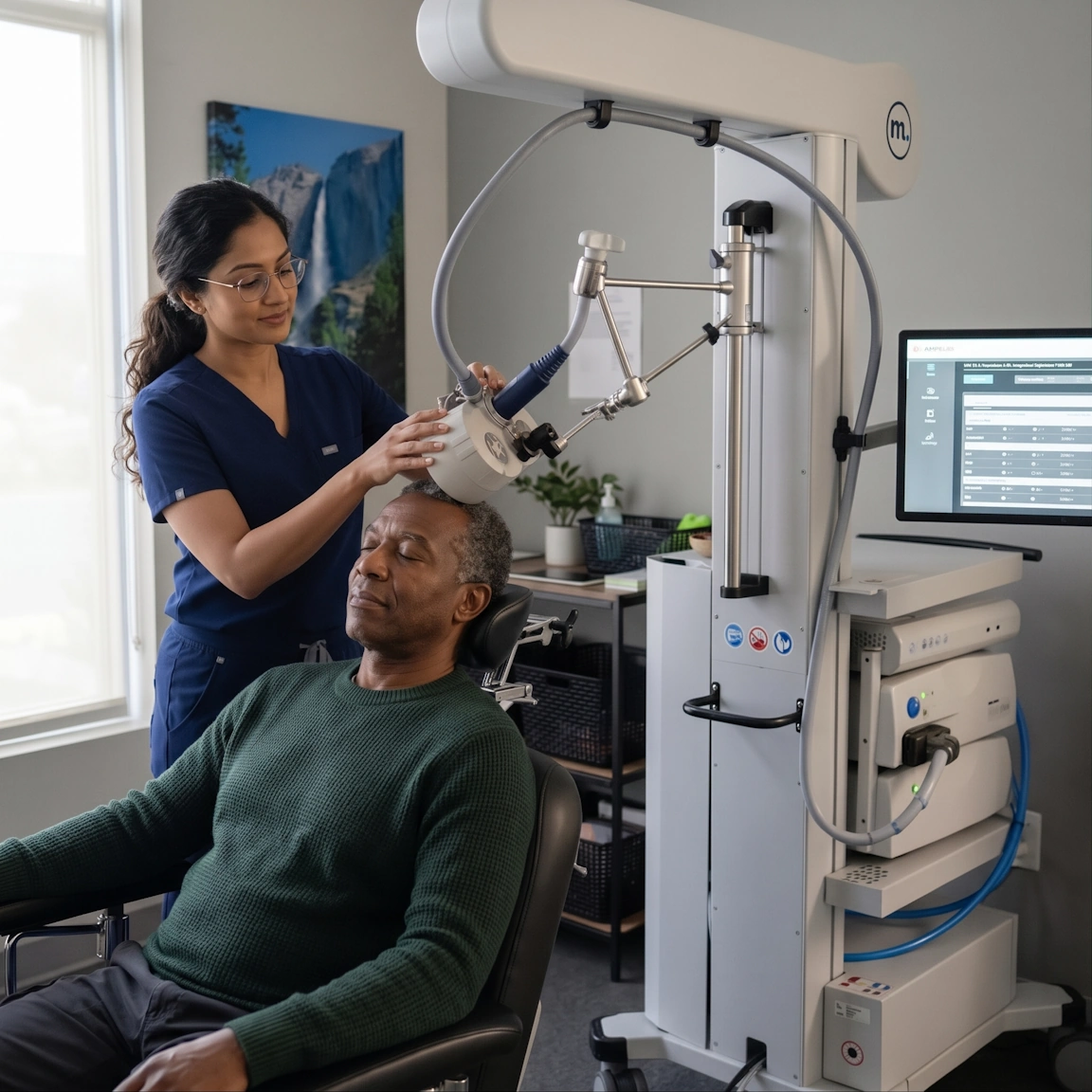
TMS works by using magnetic pulses, similar technology to what runs an MRI machine, to stimulate the prefrontal cortex. This is a brain region involved in mood regulation that tends to be underactive in depression. Armstrong Family Counseling delivers TMS using the NeuroStar Advanced Therapy System, one of the most established devices in the field, though the specific equipment matters far less to most families than how the treatment actually works. Lifting that depressive weight can make the rest of PTSD, the nightmares, the hypervigilance, the avoidance, noticeably easier to carry, even though TMS isn’t targeting those symptoms directly.
How TMS Treats Depression on Its Own Terms
Not everyone in a military family dealing with depression also has PTSD, and TMS stands on its own for that group too. The treatment was originally FDA-cleared for major depressive disorder in 2008, later cleared for OCD in 2018 and as an aid in smoking cessation in 2020.
Most major insurers and Medicare cover TMS for major depressive disorder once someone hasn’t had adequate improvement from at least one antidepressant trial, usually with prior authorization. That’s a real, established path, not an unusual exception a family would need to fight for.
Is TMS Safe? What Military Families Ask First
Safety is almost always the first question for any medical treatment and TMS has a stellar safety record. TMS is non-invasive. There’s no anesthesia or sedation involved, and patients stay awake and alert throughout each session. Most people drive themselves home afterward and go straight back to their day.
The most common side effect is mild scalp discomfort or a headache near the treatment site, which usually eases with over-the-counter pain relief and tends to diminish as treatment continues. Seizure risk exists but is rare, with incidence well under 1 percent.
Because TMS doesn’t circulate through the bloodstream the way a pill does, it avoids the systemic side effects that come with many antidepressants: weight gain, sexual dysfunction, GI issues, emotional blunting, drowsiness. It also carries no drug interactions. That’s genuinely relevant for service members and veterans who may already be managing medication for service-connected physical injuries, or who have real, understandable concerns about how a new medication might affect cognitive sharpness, fitness-for-duty requirements, or security clearance considerations.
A Treatment Option for the Whole Family, Not Just the Veteran
Because TMS is medication-free and interaction-free, it is an excellent treatment option for any family member dealing with depression, not only the person who served. A spouse worn down by years of supporting a partner through PTSD deserves the same consideration. So does another family member whose depression traces back to deployment separations or the disruption of moving every few years. Any of these situations should still be evaluated by a licensed provider before TMS becomes part of the plan, but the option belongs on the table for the whole household, not reserved for one person in it. TMS is currently approved for patients ages 15 and older.
What a Course of TMS Actually Looks Like
Armstrong Family Counseling offers the standard TMS protocol, not one of the newer accelerated formats that compress treatment into multiple sessions a day. A full course is 36 sessions total: typically five sessions a week for about the first six weeks, then tapering to three sessions a week for about three more weeks, roughly seven to nine weeks in total. Individual sessions generally run somewhere between 19 and 40 minutes. Patients stay alert the entire time and can drive themselves to and from each appointment. For people juggling service obligations, shift work, or caregiving at home, being able to return to normal responsibilities the same day matters just as much as the treatment itself.
Getting Started in Kansas City
Armstrong Family Counseling’s psychiatry services are currently based out of the Overland Park location. The practice’s existing trauma counseling and family counseling services pair naturally with TMS therapy for military families navigating PTSD, depression, and reintegration together, since medical and emotional support tend to work best side by side.
Details like current pricing and insurance verification are best handled directly, so call (913) 204-0582 to talk through whether TMS makes sense for you or someone in your family.
Frequently Asked Questions
Is TMS FDA-approved for PTSD? Not specifically. TMS is FDA-cleared for major depressive disorder, and PTSD and depression frequently occur together. Treating the depression component effectively is a real clinical benefit for someone with both conditions, even though TMS’s clearance is for depression rather than PTSD itself.
Is TMS safe for veterans who are already taking other medications? TMS doesn’t circulate through the bloodstream the way a pill does, so it doesn’t carry drug interactions the way many medications do. That makes it a reasonable option to discuss for veterans already managing medication for other service-connected conditions, though a licensed provider should always review your specific situation first.
Can spouses or children of service members get TMS for depression too? Yes, when a licensed provider determines it’s appropriate. Spouses and other family members of deployed or returning service members experience elevated rates of depression and anxiety, and TMS being medication-free makes it worth considering for any family member dealing with depression, not only the veteran.
How long does a full course of TMS take? Armstrong Family Counseling offers the standard protocol: 36 sessions total, typically five days a week for about six weeks and then tapering to three days a week for about three more weeks, roughly seven to nine weeks in total, with individual sessions lasting about 19 to 40 minutes.
